
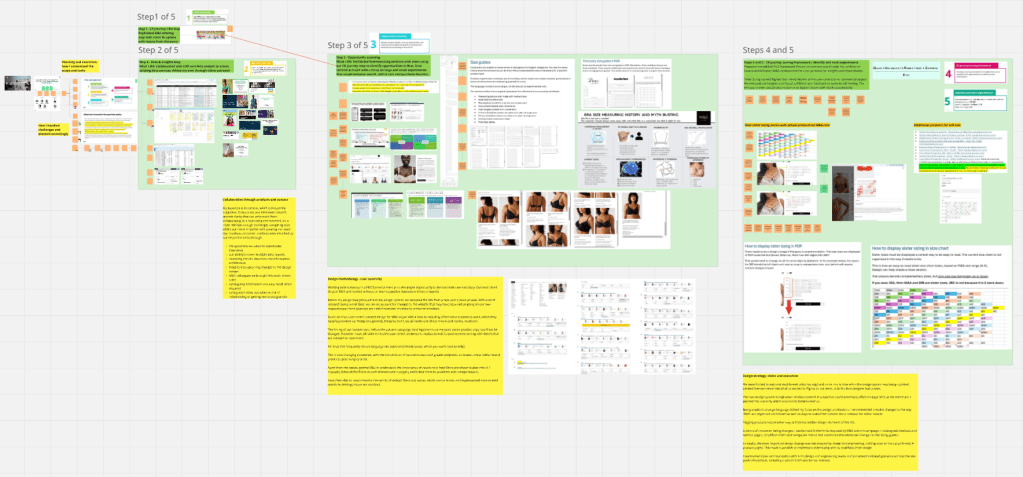
In 2024 I joined a team consulting with Marks and Spencer (M&S)
Team and stakeholders
There were 4 of us:
- Product designer (Team lead)
- Data analyst
- UX researcher
- Content designer
We worked with:
- Head of UX
- Product design manager
- Product managers
- UX researchers
- Site optimisation team
- Lingerie development team
Goal
Enhance conversion optimisation at all stages of the customer journey. Working independently of their UX research team, we identified unrealised opportunities and experimented with solutions.
Researching hidden opportunities
We read M&S internal research reports and developed a stakeholder map to divide interviews between the 4 of us.
I found our first significant opportunity in sales data, the kind that would go unnoticed by everyone, unless they had specialist knowledge about bras.
I focused on Lingerie because I have direct industry experience. In 2013 I helped build a 0-to-1 ecommerce site for an Australian lingerie retailer. I put that knowledge to M&S’ benefit, working with researchers, data analysts and the site optimisation team.
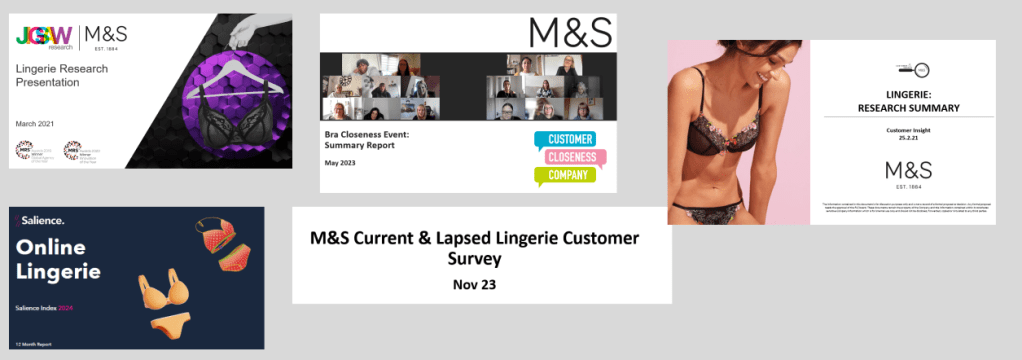
M&S are the UK’s leading bra retailer with the most extensive size range on the high street (A-K).
- 40.4% market share (as of Nov 2024)
- 1 bra sold every 2 seconds
- Almost half of all UK women shop M&S
- Size range split into A-E and F-K
- Average UK bust size between C and DD
I raised our first major opportunity from sales data, one that would remain hidden unless you knew about bras.
Situation – M&S losing size F-K buyers to rivals
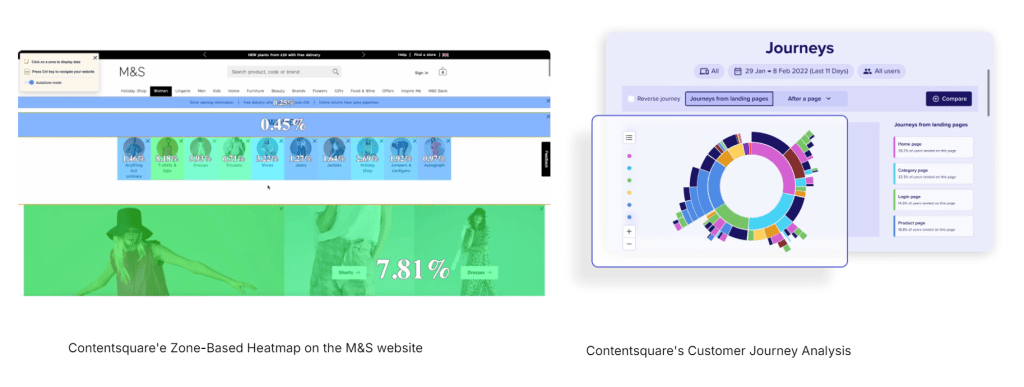
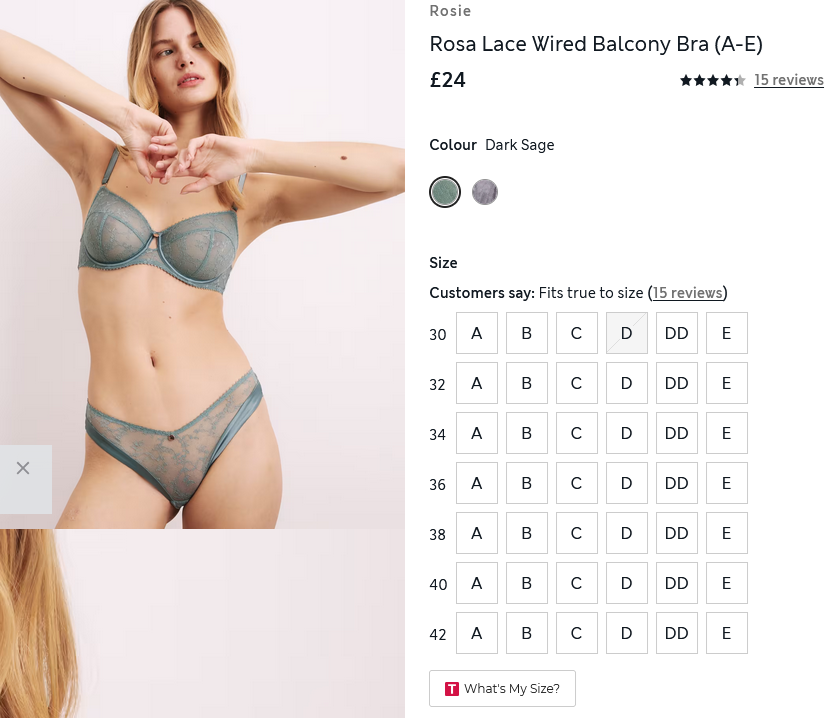
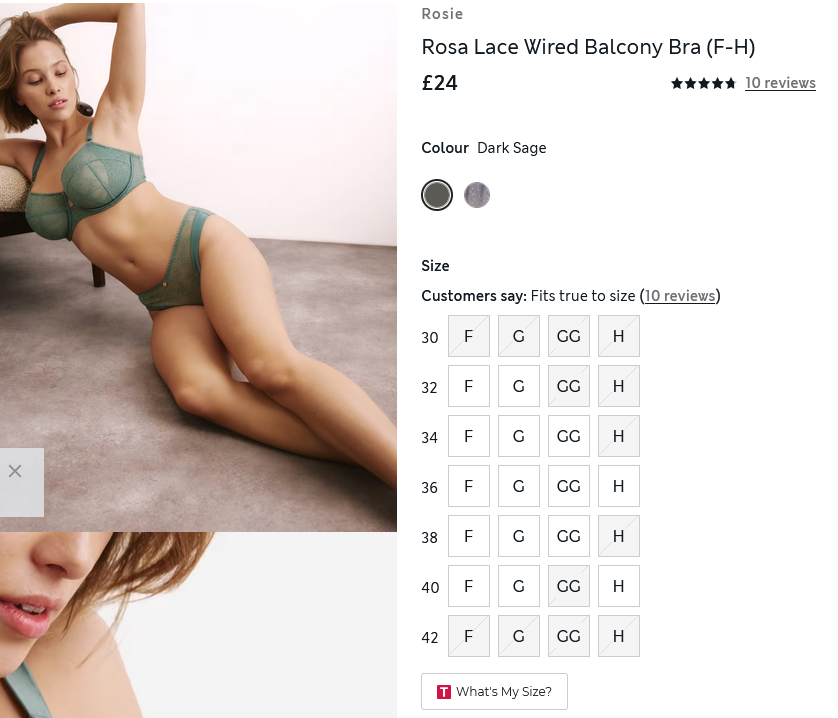
I noticed a pattern of significantly more demand for size F-K bras than supply online, by looking at product display pages on site. I followed up by looking at analytics data. A data analyst helped me cross-reference the numbers with M&S research to verify that an opportunity existed and that it was statistically significant and free from bias.
The average UK bust size is between C and DD.
Size F-K can be harder to find buy at any retailer, which encourages online shopping. Unsurprisingly:
- M&S online data showed many F-K bras sold out faster and more often than A-E
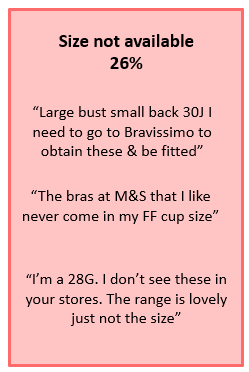
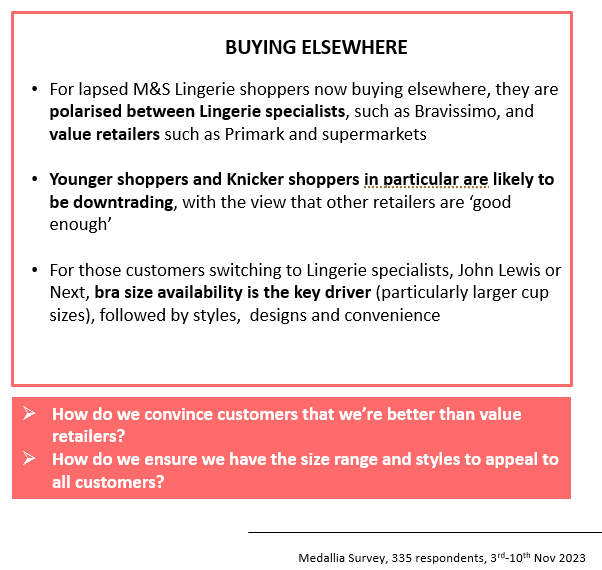
- Running out of F-K sizes pushed customers toward expensive, unrecognised online sites
- M&S customer feedback: “unhappy paying more from sites they don’t know“
- How could M&S could keep F-K customers on-side and on-site until restock improves?
From my previous lingerie industry experience in Australia (Bendon Lingerie, 2013-14), it occurred to me that a concept called ‘sister sizing’ could potentially help buyers and give M&S revenue-positive and cross-marketing upsides.
To confirm whether M&S was receptive to the idea of implementing sister sizing, I needed to consult with the M&S Lingerie technical team.
Task – Investigate feasibility of ‘sister sizing’ at M&S
From my stakeholder map, I found several names for product experts and met with two designers from the lingerie team.
Our meeting revealed 3 things:
- sister sizing is definitely viable and they were keen to do it
- current site content is insufficient for people to accurately measure themselves
- implementing sister sizing online could be beneficial for in-store fitting and vice-versa.
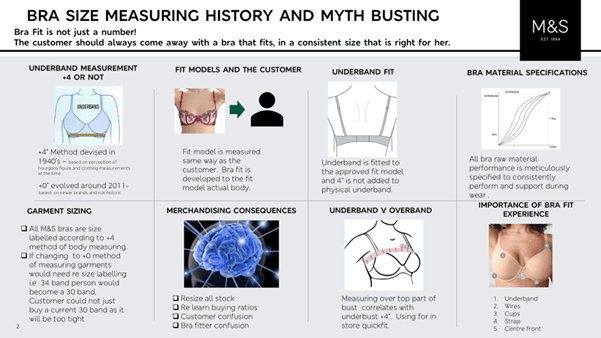
We agreed to to collaborate on implementing sister sizing online and our next step was to explain the benefits to the digital team.
Explaining ‘sister size’ to stakeholders
About bra size
UK bra sizes are mostly alphanumeric, comprising band (number) and cup (letter). Each size has a cup volume. M&S stocks sizes 28AA to 46K.
What’s a ‘sister size’?
A sister size is a bra that supports the same cup volume but has a different band and cup measurement.
In simplest terms: customers can wear three sizes, not one.
- User centred and revenue positive
- Focus on Fuller bust bras where demand exceeds supply.
- Customers disappointed by out-of-stock sizes can be encouraged to try in-stock sister sizes.
- Customers remain on M&S.com, a brand they implicitly trust.
I created the excel table below to explain sister sizes to product managers and senior Digital team stakeholders.
Using the example of 32A from the chart, a customer could also theoretically fit 34AA and 30B, all of which support the same cup volume.
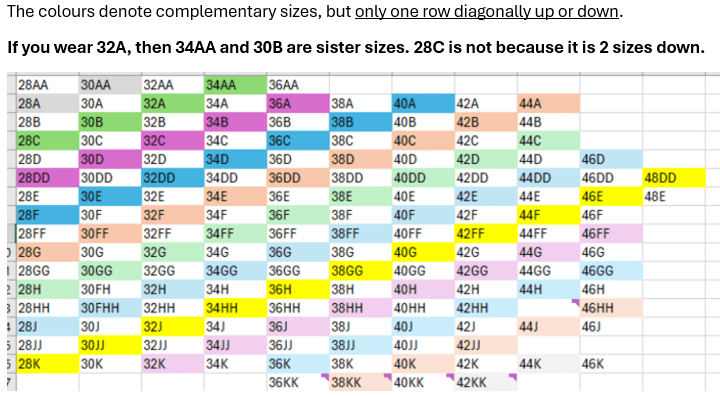
34AA = 32A = 30B
This rule helps customers understand sister size:
- Wearer’s size: 32A
- Go up a band number (32 to 34) and down a cup letter (A to AA) to the wearer’s size = 34AA
- Go down a band number (32 to 30) and up a cup letter (A to B) to the wearer’s size = 30B
I also explained how a sister sizing experiment could be launched in tandem with M&S’ efforts to encourage more women to get properly sized in-store. Each would benefit the other: sceptical online shoppers could get professional advice with no obligation to buy, and women across the country benefit from a self-care service.
Helping UK women get their size(s) right
In January 2023, M&S surveyed adult women across the UK and discovered the following:
- 93% think it’s important to get fitted during and after pregnancy
- 74% think it’s important to get fitted after weight change
- 50% think they should get fitted once or twice a year
- 50% were last fitted more than 2 to 5 years ago
- 39% think it’s important to get fitted after surgery
- 38% don’t know or are unsure if they’re wearing the right bra size
- 36% don’t think they need to know their bra size
- 35% have never had been professionally fitted
- 30% haven’t been fitted in 5 years
- 28% were unsure how often they should get a bra fit
- 19% don’t know where to go to get fitted

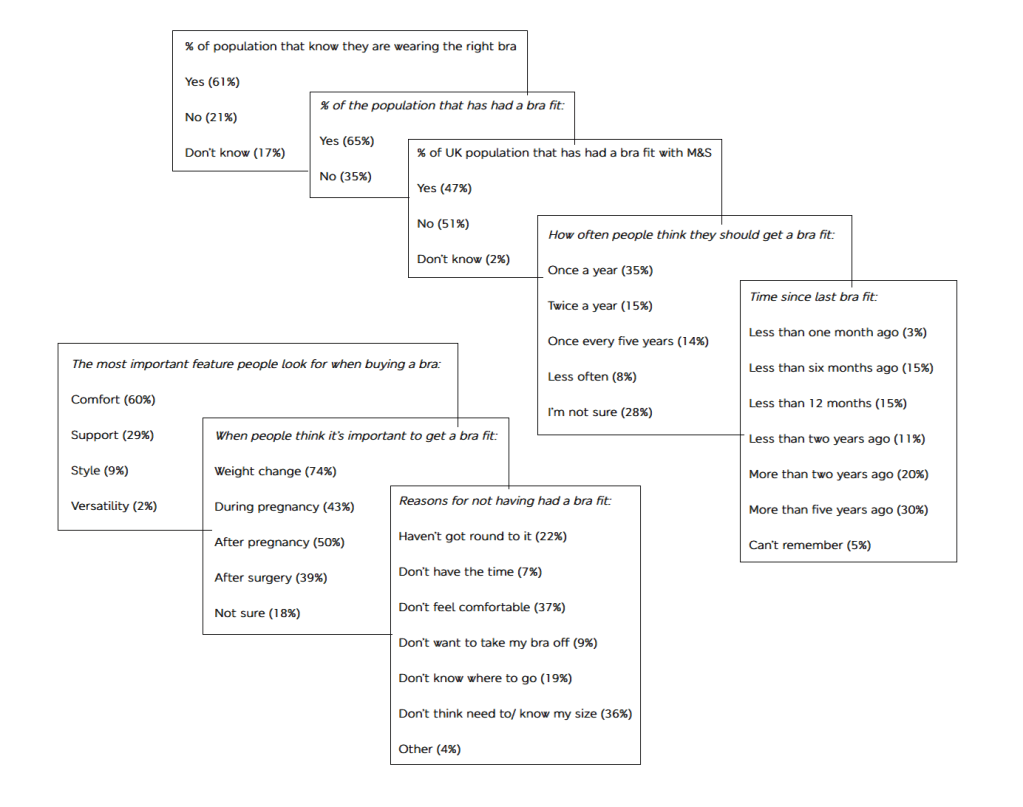
I used the information from this survey to create sister sizing specific research and refine the messaging used in our experiment.
Hypothesis
Even if an online customer’s regular size is out of stock, we can use it to recommend a complementary in-stock ‘sister size’ and create a revenue generating opportunity and educate them at the same time.
With appropriate content, M&S could avoid losing them to competitors.
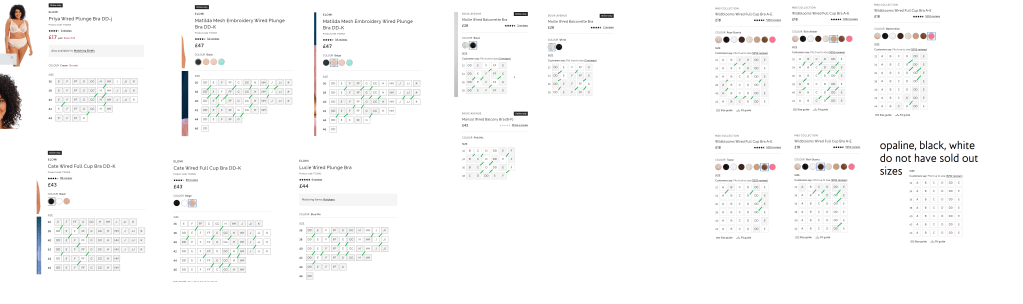
Here’s a real product example to illustrate how the experiment would work:
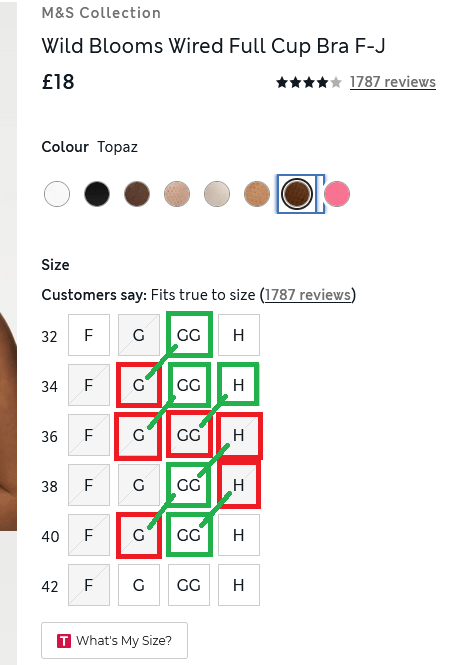
6 out-of-stock sizes (red) are eligible sister sizes to 5 available sizes (green). Together, they create 6 selling opportunities (marked by green lines). 38GG is a sister size to both 36H and 40G.
Action- Design the experiment
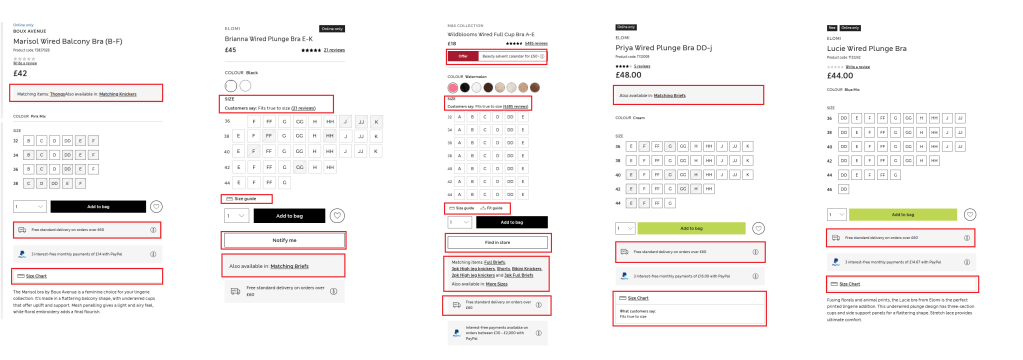
We made a minor design change to some product display pages (PDP) to enable sister size comparisons. We aligned sizes by alphabet, moving letters along the grid to maintain uniform order.
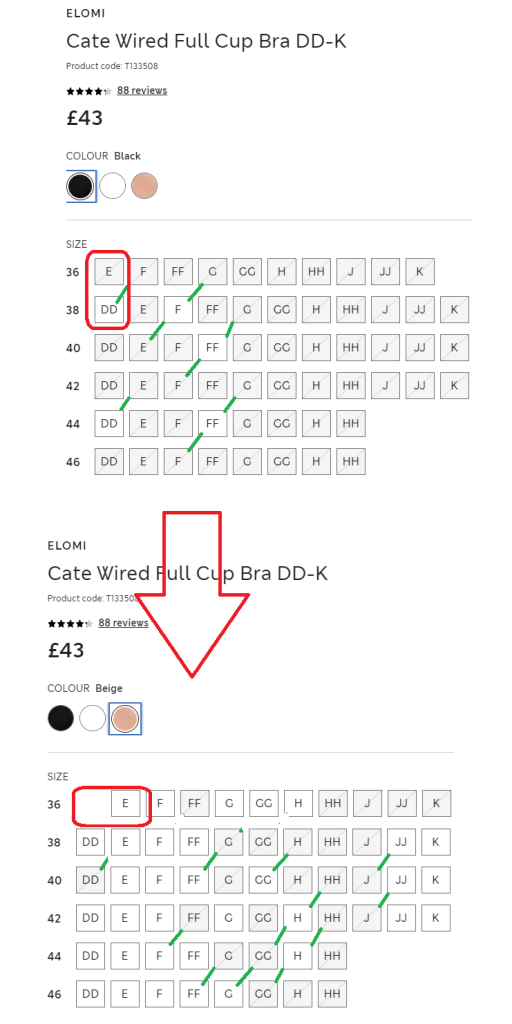
We also tested explanatory microcopy and a link about sister sizing in several different spots near the item size, as shown below. (Microcopy redacted to deter copycats)
Tie-in to existing M&S campaigns
We proposed extending the experiment by encouraging shoppers to book in for a bra-fitting in-store, with a percentage discount offer via Sparks.
Result:
- SUCCESS: Revenue generated from F-K sister size experiment
- Plan to increase experiment with A-E sizes in 2025
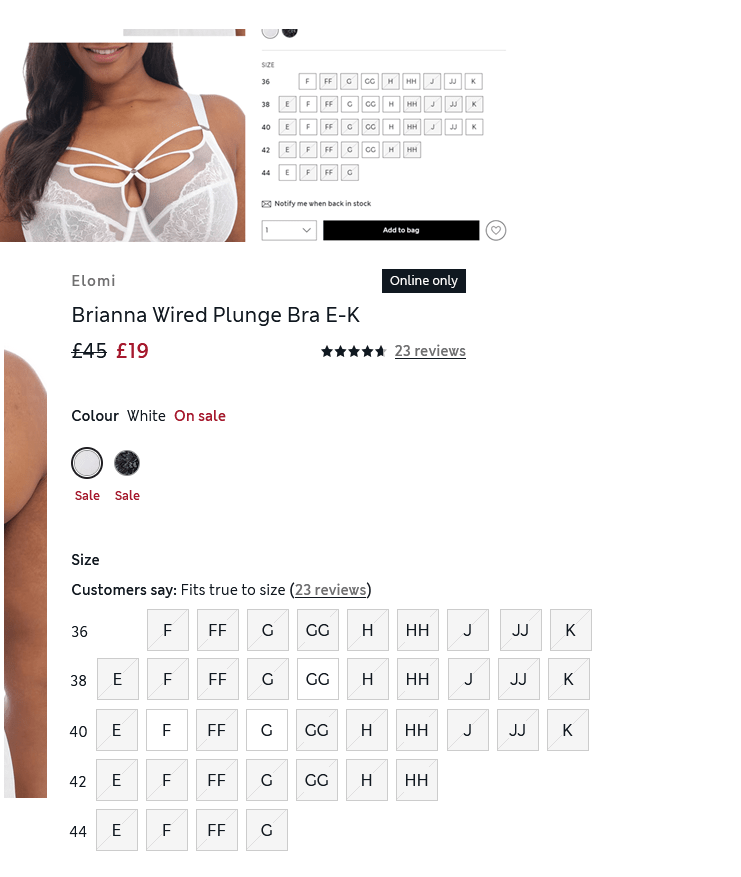
- Most successful product had 12 sizes with 15 eligible sister sizes
- It created 15 selling opportunities
- 11 out of 15 generated revenue (73.3% success rate)
- 3 sizes left unsold (including the 4 non-revenue opportunities)
- Restocked one of the 4 unsuccessful sizes for root cause experiment but results were inconclusive
- Further testing planned with different messaging in summer 2025
 Sherief Razzaque, uxwriter.work